Multi-tenant SaaS architecture
Many customers on one platform: pooled resources for most, dedicated ones where needed.
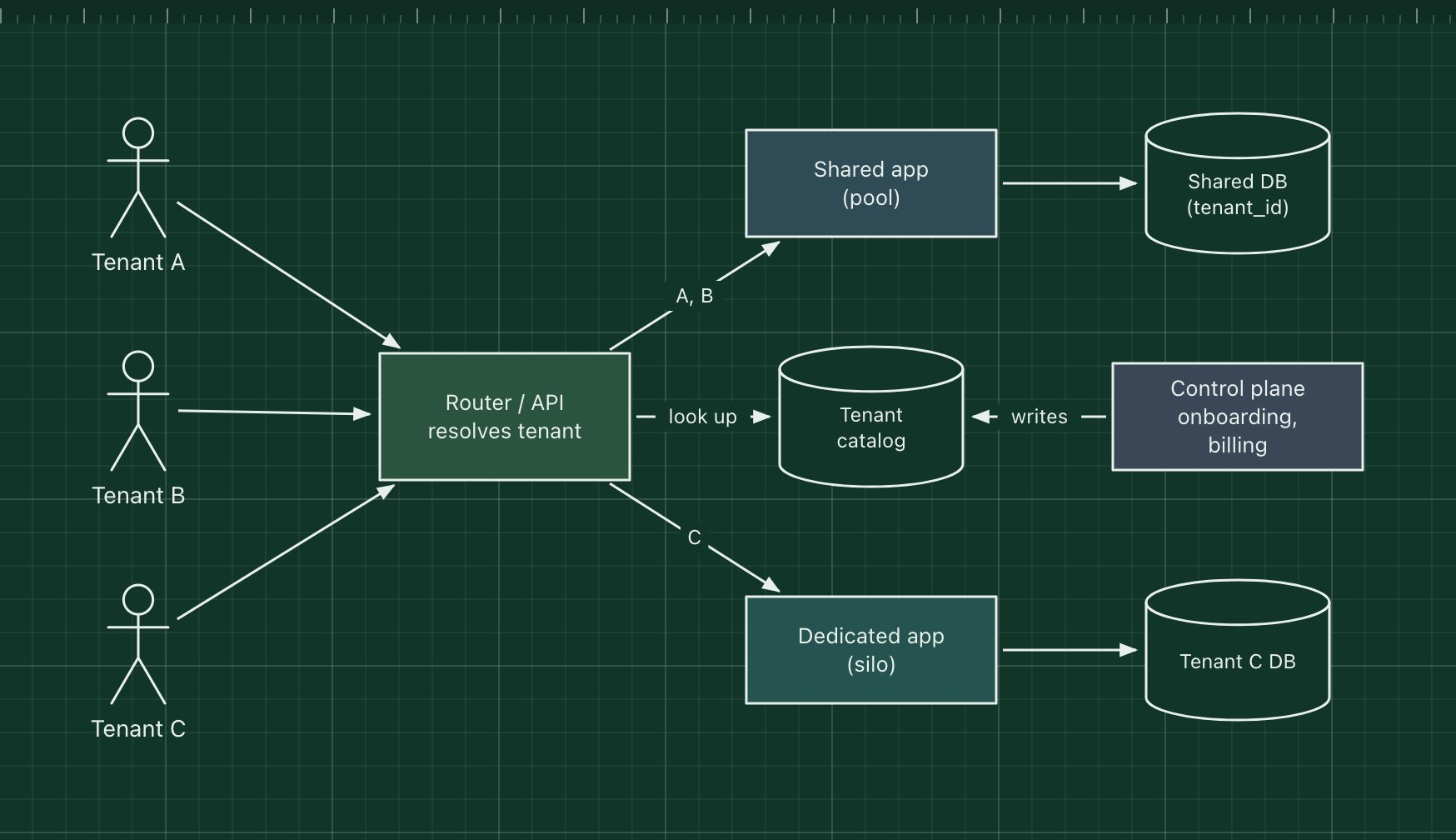
A multi-tenant SaaS application serves many customer organisations, called tenants, from one platform. The core design choice is how much each tenant shares. In the pool model tenants share the same application and database, separated by a tenant ID on every row. In the silo model a tenant gets its own resources. Most products mix both: pooled by default, siloed for large or regulated customers.
Around this sits a control plane that onboards tenants, records their plan and where their data lives, and handles billing. The application looks up each request's tenant before doing anything else.
The parts of the pattern
- Tenant resolution
- The router finds the tenant from the subdomain, a token claim or an API key.
- Tenant catalog
- Records each tenant's plan, region and which resources serve it.
- Pooled resources
- Shared app and database. Every query is filtered by tenant ID, ideally enforced by the database (row-level security).
- Siloed resources
- A dedicated app and database for tenants that need isolation, data residency or guaranteed capacity.
- Control plane
- Onboarding, plans, billing, and provisioning of silos.
How it works
- A user from tenant B signs in at b.example.com.
- The router resolves tenant B in the catalog and finds it on the shared pool.
- The shared app runs the request with tenant B's ID set, so every query only sees B's rows.
- Tenant C's requests go to its dedicated deployment and database instead.
When to use it, and when not to
Good fit
- B2B software sold to many organisations.
- You need to balance cost (sharing) with isolation and compliance (dedicated resources).
- Tenants on different plans need different limits, features or regions.
Think twice
- Isolation enforced only by application code with no tests or database checks: one missed filter leaks data.
- Every tenant on a silo from the start: the operational cost grows with each customer.
- Ignoring noisy neighbours: add per-tenant rate limits and quotas in the pool.
Edit this diagram
Click Open the diagram in the editor to get your own copy, saved in your browser. Rename the boxes to match your system, swap the generic boxes for technology icons from the palette, then export a PNG, SVG or PDF, or share a link. No sign-up.